Key Takeaways: Your Next Search Gatekeeper Is an AI Agent
Welcome to another installment of the monthly AI Search Pulse webinar, a recurring series where we provide impactful, engaging discussion on the latest AI search developments, strategic insights and practical guides from industry leaders in the communications space.
This month, Glenn Frates, VP, Distribution at PR Newswire and Jeff Hicks, the Chief Product and Technology Officer at PR Newswire, discussed the impact that AI agents have on discoverability and how organizations must think about visibility beyond traditional search.
You can access this and other AI Search Pulse episodes here. Meanwhile, here are some key takeaways from the latest in our AI Search Pulse series.
The AI Landscape Continues to Change Rapidly
“As this AI webinar series has moved along,” Frates states, “We always joke that when the next series comes up, things are going to change across the entire landscape for brand marketers and PR [professionals].” Just this past month alone, there were news stories, both positive and negative, about:
- AI agents escaping sandboxes to break into websites
- AI global threats
- Meta’s new AI companion
- OpenAI’s potential $1.2 trillion valuation
- Major AI companies intentionally slowing their pace
Outside of these splashy stories, one thing is clear: AI agents will be impossible to ignore for communications professionals. As of June 2026, AI bots are responsible for the majority of all web traffic (57%).
Despite the doomsday headlines, Hicks feels that, with oversight, AI agents can be powerful tools for PR professionals. “[AI] agents can provide a lot of benefits to us if they’re governed and they’re secure and …steps are taken, and I believe that these [AI] companies are coming together now to look at that and make sure that happens.”
Moving past the headlines, Frates and Hicks dove into how AI agents gather information and how to remain visible in an agentic search landscape.
There Are Three Equally Important Types of AI Bot Activity
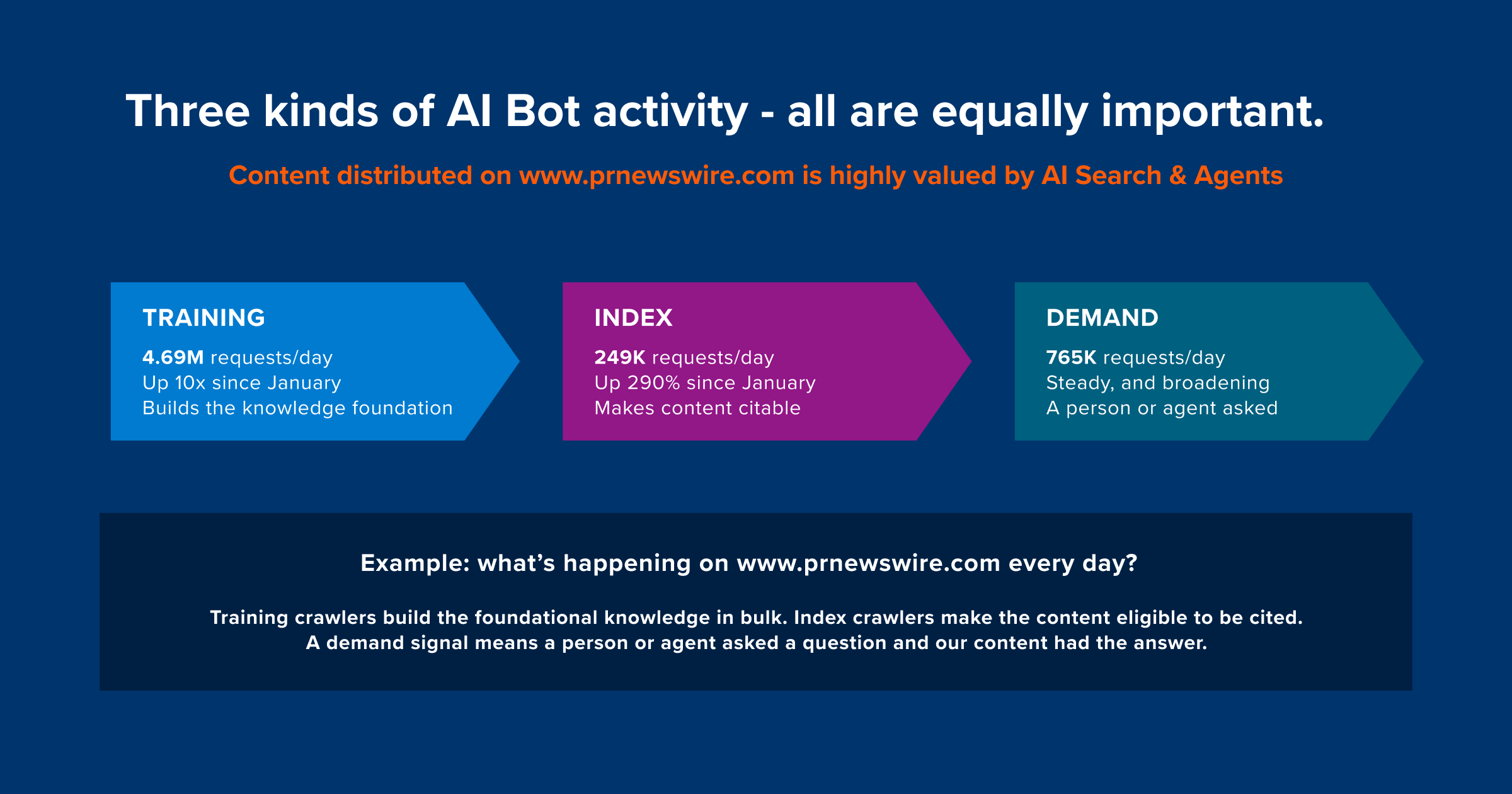
Hicks looked into content distributed on prnewswire.com and how AI bots interacted with the site to get a sense of how these agents interact with websites in general. Apart from learning that the content contained in the press releases we distribute is highly valued by both traditional and AI search engines, we learned that there are three important types of traffic we see coming from AI agents.
Training
Large language models (LLMs) have to build their foundational knowledge before they can start being properly utilized. They do that through training content or taking in foundational knowledge in bulk to train them on future tasks or requests. PR Newswire alone sees nearly 4.7 million requests per day – a number that has grown since January 2026 – from AI agents for this purpose.
While many communications professionals see being cited by AI as a primary goal, it’s important not to overlook the value of being part of the foundational knowledge layer of a model. If your content was used for training, that model will still mention your brand even if you aren’t being cited.
Index
AI Agents are also important for indexing – AI agents make nearly 250,000 page index requests per day for PR Newswire alone, another large lift since January. These requests make your content citable through search and help it show up in AI search results.
Demand
Finally, AI agents send over 750,000 demand signals a day through PR Newswire. A demand activity occurs when a person or AI bot asks a question and, in real time, finds content from a site.
All three of these AI bot activity types are important, with training being an area that many brands fail to realize the importance of – if your content is used to train models, it only reinforces your trustworthiness and authority on the subject, which leads to increases in indexing and demand.
While this data was only pulled from PR Newswire, there are tools available like Trajaan that can help you see how you and your competitor are performing in generative AI as well as social, shopping and traditional search platforms.
How Do We Get Information Online?
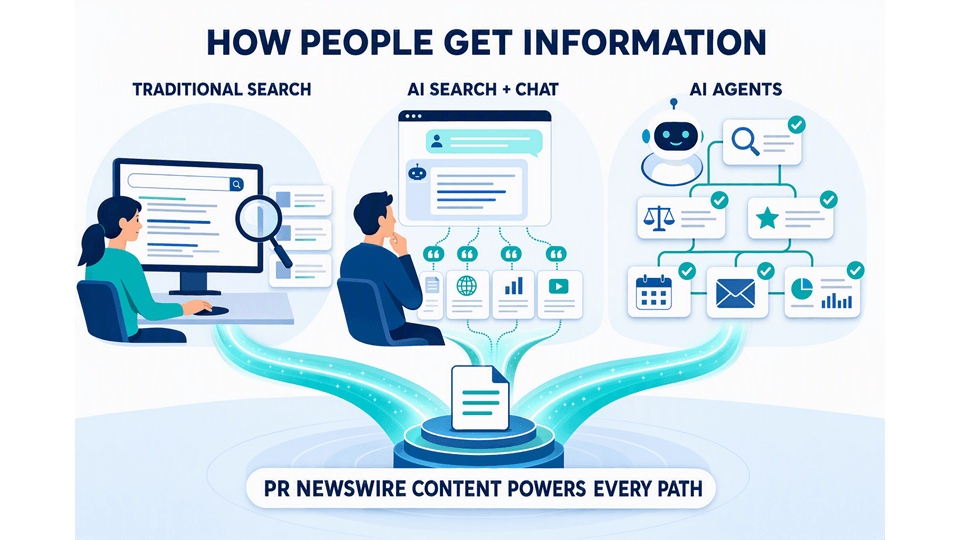
Taking a step back, it’s important to understand AI agents as another step in the evolution of how information is accessed online.
Traditional Search
The first way internet users were able to find content online was through traditional search engines, Google of course being the most ubiquitous platform. Under this model, search engine optimization (SEO) was a strong tool to guide users to your website or content.
AI Search and Chat
AI entered the landscape with AI search and chat tools such as ChatGPT or Claude. From here, the search for content expanded, with communications specialists expanding from SEO tactics to incorporate AEO (answer engine optimization) and GEO (generative engine optimization).
AI Agents
Finally, we now have AI agents that use LLMs to work autonomously. They don’t require a manual user search or for them to ask a question in a chat box. Instead, they use their LLM’s core reasoning to break down goals, select tools and execute given tasks.
Search Is Learning to Act
There has been an agentic shift in AI search, which has seen the inactive chat session – where you ask a question, get an answer from AI and decide how to proceed – shift to action. With AI agents, an agentic loop exists where you can delegate a task and have an AI plan, decide and deliver on your behalf.
There are five ways you can use AI for search, with the most advanced showcasing what AI agents can really do:
- Answer: AI can be used to reply to a single question.
- Research: Moving past a single question, running multi-step searches can provide richer results.
- Compare: Multiple options can be weighed side by side, utilizing these multiple searches to compare the results given.
- Recommend: Based on these comparisons, AI could name the best fit for the user's needs, with reasons.
- Act: The final stage of the AI Agent revolution finds AI agents that can go through the first four stages of this evolution and finally book, buy, file or send whatever the desired result would be on behalf of the user.
The Six Types of AI Agents
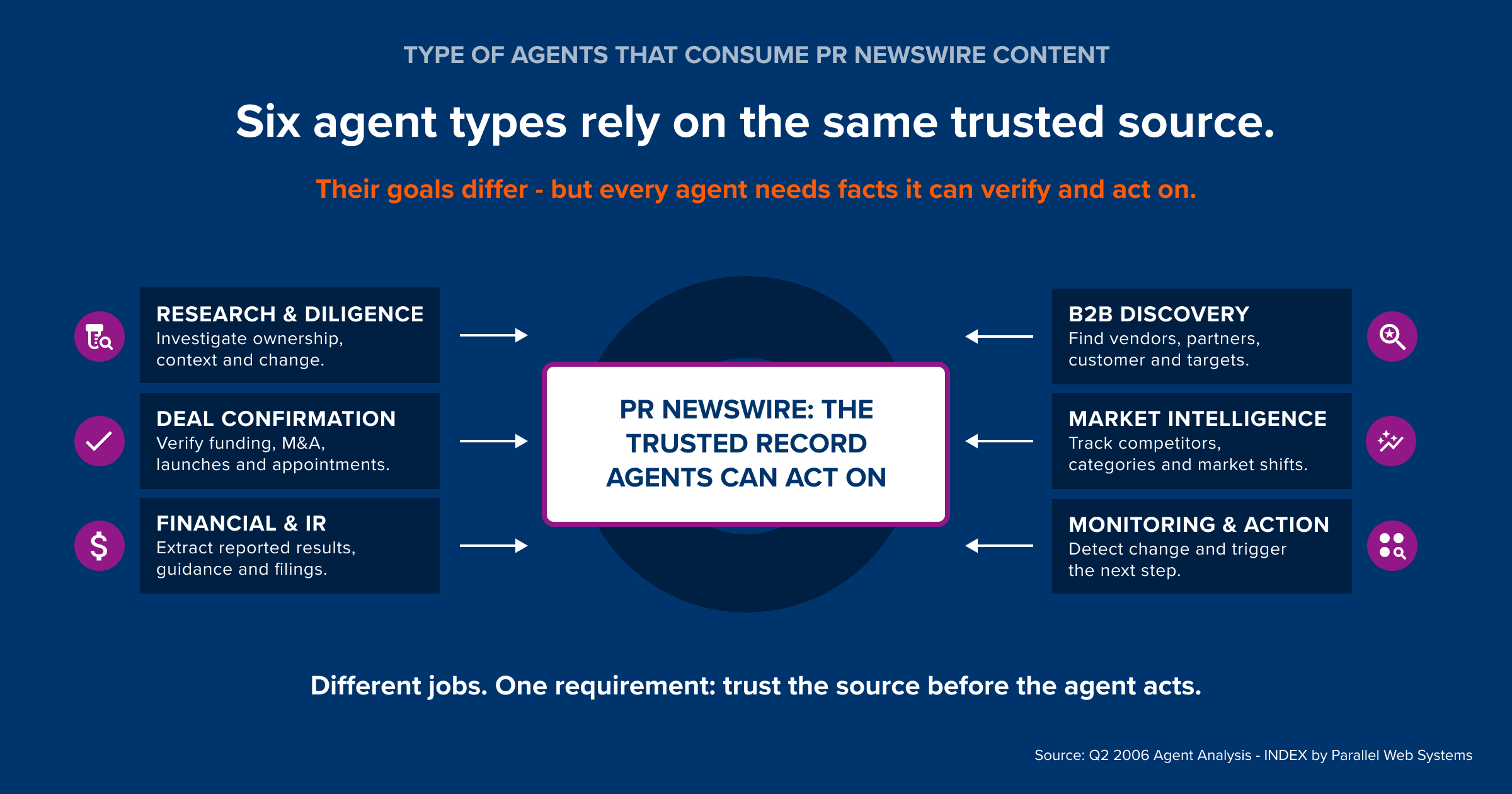
AI agents are continually evolving and can be very powerful for communications professionals looking to track competitors, crawl for marketplace intelligence and much more. While they have different goals, all of these need facts that they can verify and act on. Here is yet another example of where press releases, as well as communications structures centered around Multichannel Amplification™, are increasingly valuable for agentic discovery. While this represents only a handful of the more powerful and common agent types, PR Newswire has seen the following agents utilize our brand as a source over the past year for the following tasks.
- Research and Diligence
- These agents investigate ownership, context and change for content across a platform.
- Deal Confirmation
- Funding, mergers and acquisitions, launches and appointments are verified by these AI bots.
- Financial and IR
- Bots extract reported results, guidance and filings.
- B2B Discovery
- B2B Discovery AI agents find vendors, partners, customers and targets.
- Market Intelligence
- These bots track competitors, categories and market shifts.
- Monitoring and Action
- Agents tasked with monitoring and action detect change and trigger the next step in their processes.
These agents investigate ownership, context and change for content across a platform.
These agents and more are used for separate tasks, but they still focus on the same single source of truth, showing that content that is useful for one of these agents tends to be the content that other AI agents would look for as well.
Good Content Works for Humans AND Agents
At PR Newswire, we believe that good content that works for humans also is content that works for AI agents. This is content built using best practices that we’ve practiced over decades of experience – practices that we’ve built into PR Newswire Amplify™ to create human- and AI-friendly content.
No matter the audience, bot or otherwise, they all value content that:
- Has strong, key takeaways at the beginning
- Is easy to find
- Is easy to understand
- Is trustworthy
- Has a clear structure
- Provides useful context
- Offers credible evidence
As AI agents command more and more web traffic, the fundamentals of what makes content engaging and worth seeking out have remained the same. Content following these approaches will not only work on bots looking for training, indexing or decision-making, but will also have a positive impact on the human reader as well.
Takeaways
Regarding AI agents, Hicks cites one thing communications professionals should be on the lookout for: “Agents are going to continue to grow [and] provide more assistance and capability for users across many different industries…Keeping your eye on [them] as a potential new audience is very important as that develops. [By] applying the same Multichannel Amplification™ principles that we apply for humans, for AI search and for agents is [key] to build[ing] your narrative with authority in this new agentic world.”
By following the key principles built for SEO, AEO and GEO success, you should continue to find success in an increasingly AI bot-driven world.
Some Frequently Asked Questions about AI Agents
What is an AI agent?
An AI agent is an AI system that can autonomously research information, compare options, make recommendations and take actions on a user’s behalf.
How do AI agents affect content discoverability?
AI agents increasingly crawl, index and retrieve online content, making it important for organizations to create authoritative, structured and credible content that agents can easily understand and verify, such as press releases.
Why are press releases valuable for AI agent discovery?
Press releases can provide credible, structured information that AI agents can easily use for training and indexing purposes, since they provide structured information from a source of truth.