""Employees are staying put as outside opportunities feel more limited and internal experiences improve," said Melissa Jezior, president and chief executive officer of Eagle Hill Consulting. "However, we found that confidence in organizations is slipping, and generational differences are becoming more pronounced. Employers that understand and respond to these shifts will be best positioned to retain talent and build a resilient workforce."
"Employers should recognize that periods of low mobility can create hidden pressures, including stalled career growth and unaddressed skill gaps," Jezior added. "This is a critical moment for leaders to focus not just on retention, but on actively developing and engaging their workforce for the future."
The Retention Index findings follow last week's Job Openings and Labor Turnover Survey (JOLTS) report. The JOLTS report indicated that the quits rate, which measures the monthly percentage of people voluntarily leaving their jobs, dropped to 1.9%. That data matches the lowest quits level since 2020, suggesting that people are less confident in their ability to find a new job.
Key Retention Index Indicators:
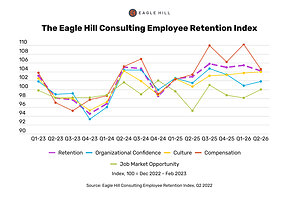
- Compensation Indicator: Increased sharply (+4.0), reaching a record high
- Culture Index Indicator: Continued steady growth (+0.4), remaining near peak levels
- Job Market Opportunity Indicator: Declined (-0.6) for the second consecutive period
- Organizational Confidence Indicator: Dropped (-2.5), reaching its lowest level since 2024
Generational Divide Widens Across Workforce
The Index reveals a nearly 20-point gap in retention outlook between younger and older workers. Gen Z and Millennials are the most likely to stay, while Gen X and Baby Boomers show increasing signs of attrition risk. This divergence reflects differing expectations, experiences, and levels of confidence across career stages.
Organizational Confidence Declines as Workforce Sentiment Shifts
The Organizational Confidence Indicator fell for the second consecutive quarter, signaling declining employee faith in leadership and organizational direction. While workers remain in place, this drop suggests growing uncertainty about the future, an early warning sign for employers.
Retention Stability May Mask Longer-Term Workforce Challenges
While high retention can signal stability, it may also present challenges. When employees are less likely to leave, organizations may experience slower internal mobility, limited advancement opportunities, and reduced workforce agility. Over time, this can impact engagement and make it harder to adapt to changing business needs.
The Eagle Hill Employee Retention Index is a first-of-a-kind market indicator that tracks worker sentiment across four proven drivers of retention: organizational confidence, culture, compensation, and job market opportunity.
- The Organizational Confidence Indicator measures how confident employees are in their organization's future and leadership.
- The Culture Indicator looks at employee sentiment about their workplace culture, connections, and whether they feel valued and recognized
- The Compensation Indicator measures how employees view their compensation, benefits, and ability to grow their compensation at their organization.
- The Job Market Opportunity Indicator measures how employees perceive external prospects for employment and job security in the near term.
Each month, the Eagle Hill Consulting Employee Retention Index measure shifts in workforce retention based upon ongoing employee opinion surveys on factors related to worker intentions to change jobs. As the Employee Retention Index increases, it signals an increase in retention in the next six months. As the Employee Retention Index decreases, it signals to employers that workers are more likely to leave their jobs, and organizations can expect more turnover in the next six months.
The Eagle Hill Consulting Employee Retention Index is based on a monthly omnibus survey conducted by IPSOS of a nationally representative sample of U.S. adults employed full or part time. Quarterly indices and reports are issued based on a minimum of 1,200 aggregated responses per quarter. Respondents are polled on a range of workforce topics including organizational confidence, culture, compensation, and job market opportunity.
The survey commenced in December 2022, and the most recent data was collected from January – March 2026.
Eagle Hill Consulting LLC is an award-winning business that provides unconventional management consulting services in the areas of Organizational Performance, Business Intelligence, Technology Enablement, Talent, and Change Management. The company's expertise in delivering innovative solutions to unique challenges spans across Fortune 500 companies, government agencies, and global nonprofits. Eagle Hill has offices in the Washington, D.C. metropolitan area, Boston, MA, and Seattle, WA. More information is available at www.eaglehillconsulting.com.
SOURCE Eagle Hill Consulting LLC








Share this article