


WorkWhile Flex Work Nation 2026 Report shows Higher Confidence in AI Driven by the Earnings and Work Predictability it Offers.
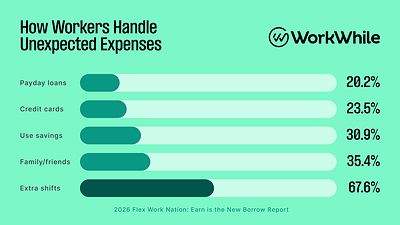
SAN FRANCISCO, July 15, 2026 /PRNewswire/ -- WorkWhile today released its annual report, Flex Work Nation: Earn is the New Borrow, based on a survey of 3,083 hourly workers across the United States. The central finding reframes how the nation in general and businesses in particular perceive the hourly workforce: Reliable, Accountable and Financially Savvy as 34% of workers have become debt-free and 67.6% of them pick up an extra shift rather than borrow, nearly triple the share who reach for a credit card.
For the businesses that hire hourly workers, that instinct to earn is the report's core argument. A workforce that depends on its shifts to get through a tight month is a workforce that shows up for them, which is exactly what drives high fill rates, low cancellations, and reliable coverage on the hardest days to staff.
"Against a backdrop of AI job loss gloom and doom, the US Hourly Workforce outsmarted everyone else to get out of debt, reach financial stability and leverage sweat equity to defy stubborn inflation and predatory lending" said Simon Khalaf, CEO of WorkWhile. "Validating our thesis behind WorkWhile, our workers demonstrated reliability and fiscal discipline and our customers are taking notice".
The report organizes its findings into seven narratives, each with a direct implication for employers, including:
- Earning over borrowing. 67.6% respond to a sudden expense by working more, even though only about half hold any savings. The instinct to earn rather than borrow holds across the community.
- Flexible work is the strategy. Only 9.3% want a traditional job alone. The rest deliberately build a mix of income sources, most pairing a traditional job with WorkWhile. In a year when 40.2% of workers experienced a job loss, income diversity has become the new job security.
- A workforce climbing, not just coping. 34% of workers are now debt-free. 57.8% name improving their credit as a top financial goal, and 54.2% report higher financial confidence since joining. Workers building toward long-term goals churn less.
- Openness to AI. Among workers who expect AI to change their jobs, positive views now outnumber negative ones, and positive sentiment rose year over year. The workforce often cast as automation's biggest loser is watching to see what AI does for the job, and reserving judgment.
A section on Gen Z pushes back on the idea that the youngest workers are disengaged, finding that the generation often written off as checked out is among the most financially motivated and optimistic in the survey, and the most determined to work on its own terms.
The report closes with an action plan for employers navigating an AI-shaped labor market, making the case that the most reliable hourly workers are the ones with the most reason to be there.
The full report, including demographic detail, the seven trends, and worker stories, is available at workwhile.ai.
About WorkWhile
WorkWhile.ai is an AI-native, worker-first labor platform helping businesses source, manage, and optimize hourly workforces. By combining predictive intelligence, automation, and flexible staffing infrastructure, WorkWhile helps enterprises improve reliability, workforce efficiency, and operational performance while delivering financial stability, work predictability and delight to 1.4 million workers. WorkWhile is backed by Khosla Ventures, Citi Impact Fund, Reach Capital, and Rethink Impact.
SOURCE WorkWhile




Share this article