


New Research Finds Workers Are Leveraging AI for Career Mobility as Employers Struggle to Keep Pace
New University of Phoenix Career Institute® Career Optimism Index® study points to an emerging shift in workforce power dynamics: while employees "job hug" in a stabilizing but constrained labor market, many are quietly using AI to build skills, boost confidence, and explore career mobility – creating new talent retention risks for employers.
PHOENIX, April 14, 2026 /PRNewswire/ -- University of Phoenix Career Institute® today released its sixth annual Career Optimism Index® recurring national workforce research study of 5,000 U.S. working adults and 1,000 employers fielded January 21–February 6, 2026. The study found that while workers appear to be "job hugging" in a stabilizing labor market where mobility remains limited, many are quietly using AI to build their skills, boost confidence, and position themselves for greater career mobility – potentially preparing for their next move, which could be away from their current employer.
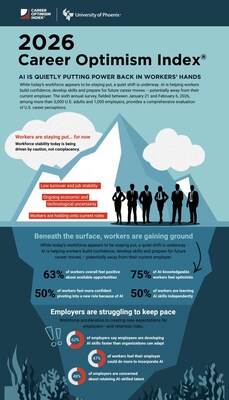
On the surface, the landscape favors employers: companies are deploying AI to increase productivity, reshape teams, and find efficiencies, according to the World Economic Forum's latest AI at Work report. But the 2026 Index points to a new dynamic underway: half of workers (50%) say AI makes them more confident about pivoting to a new role – signaling an impending shift from "job hugging" to "job hopping" that puts power back in workers' hands. The last time workplace power was firmly in employees' hands was in 2022, when employers saw a mass exodus of talent seeking greater mobility and opportunity, as highlighted in the 2022 Career Optimism Index® study.
This year's Index shows workers are increasingly turning to AI independently to strengthen their readiness in a business environment characterized by historically low turnover rates, as illustrated in the U.S. Bureau of Labor Statistics' January JOLTS report. More than half of workers (53%) say AI advancements boost confidence in building their skills, while 75% say AI increases their confidence at work, and 81% say it helps them identify new ways to apply their skills for future growth.
This AI-driven confidence is translating into optimism: 63% of workers say they feel positive about job opportunities available to them, rising to 75% among workers who have become comfortable and knowledgeable about AI. As job growth shows signs of strengthening, according to the U.S. Bureau of Labor Statistics' March Employment Situation report, this may mark the moment many workers have been quietly preparing for – when rising confidence and AI-driven skill building begin to translate into increased career movement. At the same time, nearly half of employers (48%) worry they cannot retain AI-fluent talent, highlighting AI capability as both a competitive advantage and a looming retention risk.
Key Findingsfrom the 2026 Career Optimism Index®
- AI is increasing workers' confidence in career mobility: 50% of workers say AI makes them more confident about pivoting into a new role, and workers who are knowledgeable about AI report even greater optimism about available job opportunities than workers overall (75% vs. 63%).
- Workers are learning AI independently: Half of workers (50%) say they are learning to use AI independently, pointing to strong employee demand for AI skill-building even without formal employer support.
- Employees are looking for more AI guidance: Many workers say employer support has not kept pace with their needs, with 47% saying their employer should be doing more to incorporate AI into their work and 60% wanting more guidance in learning AI tools.
- Retention concerns are rising: Nearly half of employers (48%) worry they may be unable to retain AI-fluent talent as demand for those skills continues to grow, and 62% say employees are developing AI skills faster than the organization can adapt.
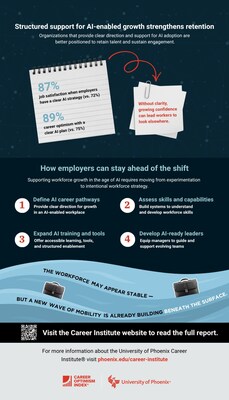
- Clear AI strategy improves job satisfaction: Workers whose employer has a clear plan for AI-enabled growth are significantly more likely to be satisfied in their current job than those whose employer does not (87% vs. 72%).
Why This Matters Now
As organizations accelerate AI adoption, the 2026 Index identifies that workforce implications extend beyond productivity and efficiency. For workers, AI is becoming a tool for career growth, confidence, and mobility. For employers, that creates a new challenge: the same capabilities that help employees become more effective in their current roles may also make them feel more prepared to plan their exit.
"AI is changing the workforce conversation in real time," said John Woods, Provost and Chief Academic Officer at University of Phoenix. "While many organizations are focused on how AI can improve efficiency, our 2026 Career Optimism Index® study shows workers are focused on how to use AI to help them grow and advance their careers. For employers, this is an important moment to lead with AI clarity, because organizations that make AI part of a broader growth strategy for their people may be better positioned to support engagement, satisfaction, and retention – particularly as hiring shows signs of strengthening and workers gain more confidence to explore new opportunities."
The findings suggest employers have an opportunity to move from AI experimentation to workforce strategy by defining clear AI career pathways and standards, establishing skills assessment systems that support talent management and internal mobility, expanding workforce training and structured enablement, and building AI capability among managers to foster a stronger culture of AI support.
View and download the complete study at https://www.phoenix.edu/career-institute.html.
ABOUT THE CAREER OPTIMISM INDEX®
The Career Optimism Index® study is one of the most comprehensive studies of Americans' personal career perceptions to date. The University of Phoenix Career Institute® conducts this research annually to provide insights on current workforce trends and to help identify solutions to support and advance American careers.
The sixth annual study, fielded between January 21, 2026-February 6, 2026, surveyed 5,000 U.S. adults who either currently work or wish to be working on how they feel about their careers at this moment in time, including their concerns, their challenges, and the degree to which they are optimistic about their careers. The study was conducted among a nationally representative sample of U.S. adults (ages 18 and up). The study also explores insights from 1,000 U.S. employers who are influential or play a critical role in hiring and workplace decisions within a range of departments, company sizes, and industries.
ABOUT UNIVERSITY OF PHOENIX CAREER INSTITUTE®
Housed within the university's College of Doctoral Studies, the Career Institute conducts impactful research and collaborates with leading organizations to explore broad and persistent barriers to career growth. Through the Career Optimism Index® annual studies and targeted reports, the Institute shares actionable insights to inform solutions. For more information, visit www.phoenix.edu/career-institute.
ABOUT UNIVERSITY OF PHOENIX
University of Phoenix is Built for Real Life. 50 Years Strong. The University innovates to help working adults enhance their careers and develop skills in a rapidly changing world through flexible online learning, relevant courses, academic AI pillars, and skills-mapped curriculum for associate, bachelor's and master's degree programs. Active students and alumni have access to Career Services for Life® resources including career guidance and tools. For more information, visit phoenix.edu.
SOURCE University of Phoenix






Share this article