


Weathering the Storm
UNICEF programme funded by Education Cannot Wait and partners helps flood-affected children return to learning and enhances school resilience to climate shocks in Kenya.
KILIFI COUNTY, Kenya, Dec. 27, 2025 /PRNewswire/ -- In the heart of Kilifi County, where the memories of a devastating flood still linger, the sound of children's voices is starting to fill the air once more. Just one year ago, Tunzanani Primary School was submerged under catastrophic floodwaters, leaving a landscape of destruction.
For 13-year-old Margaret and 12-year-old Gabriel, the torrential downpour and ensuing floods in Kenya threatened to end their dreams of completing their education and entering the field of science. The classmates watched as their school, in the path of the flood, was destroyed. Their studies, hopes and futures seemed to vanish in the deluge.
But even as floodwaters washed away their books and supplies, the community's determination to keep learning afloat endured. Through funding from Education Cannot Wait (ECW) and Postcode Education Trust, a UNICEF programme is ensuring that Margaret, Gabriel and crisis-affected children in the country are able to continue their education.
Kenya sits on the frontlines of the climate crisis. The impacts from floods, prolonged droughts and other climate hazards create massive roadblocks toward a better future.
Before the flood – a result of heavy El Niño rains – destroyed the school compound, Margaret and Gabriel were working hard to achieve their dreams. Margaret aimed to become an eye specialist, while Gabriel dreamt of working as a scientist.
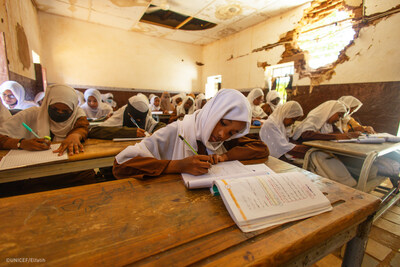
Unfortunately, their education stood at a standstill after the classrooms of Tunzanani Primary School were severely damaged. A river blocked the road to their school, and many families, already struggling with the aftermath of the disaster, couldn't afford the basics to send their children back.
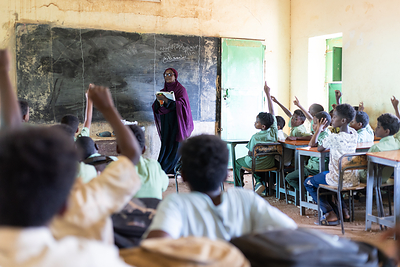
Responding quickly to the crisis, the programme helped bring children back to school by providing much-needed resources like school bags, learning and teaching supplies, and even water tanks to ensure a steady supply of clean water for students and teachers. Tunzanani Primary School is now filled with students who dream of making a meaningful impact in their community.
"When I grow up, I want to be a scientist and work in medicine to create medicines for the people," says 12-year-old Gabriel.
Margaret has also benefited from the programme's holistic support. Like many girls her age, she faced the challenge of managing menstruation without access to proper sanitary products. Her family's financial situation was a hurdle, and she recalls a shopkeeper's refusal to sell the pads on credit as her family had other pending debts.
"When I got my period, I rushed home for sanitary pads, but my mother couldn't afford them. I am grateful that my school, with support from UNICEF, provides them for us," says Margaret. For her, this small but significant provision meant the difference between continuing her education and being forced to miss precious school days.
School management has received training in mental health and psychosocial support to strengthen their ability to support students and teachers experiencing the stress and trauma caused by emergencies. The focus on capacity building has also extended to disaster risk reduction and response preparedness for future climate-induced disasters.
Millions of people in Kenya are facing a dire humanitarian crisis due to the longest drought the country has seen in 40 years. The situation has been further exacerbated by devastating floods early last year, which caused widespread destruction and left countless communities struggling to recover.
According to ECW's Global Estimates report, approximately 50% of crisis-affected children of school age worldwide live in Sub-Saharan Africa, the subregion facing the most complex challenges to guarantee the right to education of every child.
Deputy Headteacher Peninah Gambo expressed her gratitude for this holistic support, "We are grateful for this support during these challenging times. This kind gesture has significantly impacted our school, ensuring students have access to essential resources and an uninterrupted education."
As the community rebuilds, the future of children like Margaret and Gabriel remains hopeful. The goal now is not just recovery but sustainability, ensuring that schools like Tunzanani are better prepared for future challenges, whether they be floods, droughts or other climate-induced disasters.
But this work is far from done.
The floods in Kenya are a stark reminder of how climate change affects communities worldwide. Support for crisis-affected children like Margaret and Gabriel must continue, ensuring that education remains accessible despite obstacles. In the face of disaster, education is not just their right – it is a critical tool for building resilience, creating opportunities and preparing future generations to navigate a rapidly changing world.
Photo - https://mma.prnewswire.com/media/2851284/Education_Cannot_Wait_kenya.jpg
Logo - https://mma.prnewswire.com/media/1656121/Education_Cannot_Wait_Logo.jpg





Share this article