


New Study Identifies Hidden Scalp Inflammation That May Explain Why Androgenetic Pattern Hair Loss Treatments Stop Working
Open-access paper describes PIILIF, a follicle-centered inflammatory and early fibrotic pattern found even in normal-appearing scalp
MANHATTAN BEACH, Calif., Jan. 27, 2026 /PRNewswire/ -- Researchers at Dr. U Hair and Skin Clinic in the Los Angeles area report that an inflammatory, early fibrotic pattern within androgenetic alopecia (AGA), male pattern baldness and female pattern hair loss, may help explain why some people stop responding to standard "AGA-only" hair loss treatments and why results can be unpredictable in advanced or complex cases. The findings appear in Clinical, Cosmetic and Investigational Dermatology.

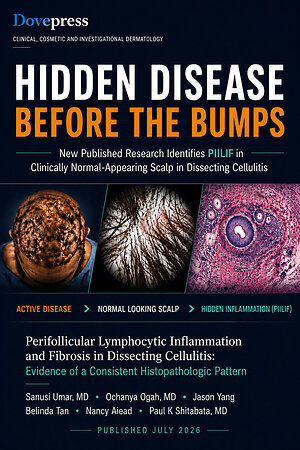
The paper describes PIILIF, a follicle-centered pattern of inflammation and early fibrosis around the upper part of the hair follicle. PIILIF can coexist with AGA and may be present even when the scalp appears normal.
"Many hair loss sufferers do all the right things, including minoxidil, finasteride and even hair transplantation, yet still experience disappointing outcomes," said Sanusi Umar, MD, board-certified dermatologist and lead author. "In a meaningful subset of AGA patients, an inflammatory and early fibrotic driver may be operating in parallel. When that biology is missed, results predictably fall short."
Study design and key findings Researchers retrospectively analyzed 129 AGA patients from a referral-center cohort. Using high-magnification imaging to guide biopsies from thinning and normal-appearing scalp, they linked microscopic findings to clinical features and outcomes.
Highlights include: • PIILIF was identified in normal-appearing scalp in 81% of patients, especially among patients 44+, with advanced hair loss or baldness, or prior poor response. • Despite frequent labeling as " seb derm" or "dandruff," true seborrheic dermatitis was confirmed on biopsy in only 0.8% of the cohort; PIILIF was present in 81%. • Among evaluable AGA-PIILIF patients treated with a plan addressing hormonal drivers and follicle-centered immunologic inflammation, 67% improved and 2% had suboptimal outcomes. • Findings support an AGA–PIILIF spectrum and suggest a dual-pathway strategy, hormonal plus immune-based inflammatory/fibrotic control when indicated, in treatment-resistant hair loss and pattern baldness.
The paper also proposes that fibrosing alopecia of patterned distribution (FAPD) aligns with a later AGA-PIILIF stage and recommends staging AGA-PIILIF by perifollicular fibrosis to support earlier recognition and intervention.
What this means for people who are not responding Most plans focus on dihydrotestosterone (DHT) control and follicle cycling support with finasteride and minoxidil. But when immune-type inflammation and early fibrosis are active around follicles, "more of the same" may not be enough. This does not mean everyone needs a biopsy. For non-responders, the study supports better biology control, better targeting and better timing, with earlier diagnostic confirmation in unclear or high-stakes cases.
Long-term care matters When PIILIF is present, the goal is not only to stimulate hair growth, but to stabilize the scalp environment. The findings support long-term, steroid-sparing anti-inflammatory strategies, similar in principle to approaches used in scarring alopecias, when clinically appropriate.
Why it matters for hair transplant planning In advanced, donor-limited, repair or post-procedure underperformance cases, scalp biology can affect predictability and durability. When inflammatory-pattern biology is suspected, the findings support scalp optimization and biopsy-informed planning rather than automatically escalating to additional grafting.
Translating the findings into clinical practice The authors encourage clinicians to adopt structured screening and management pathways to recognize inflammatory-pattern AGA earlier and integrate dual-pathway, long-term management when indicated. Dr. Umar presents one example, the Inflammatory AGA Screen (PIILIF Track) , as a model others can adopt and refine.
Medical note: This release is for informational purposes and does not provide medical advice. Individual results vary.
Media Contact: Alice Lee, PR Coordinator, Dr. U Hair and Skin Clinic; Phone: +1-310-318-1500, Email: [email protected]
Sanusi Umar, MD, is a board-certified dermatologist, founder of Dr. U Hair and Skin Clinic in Manhattan Beach, and a clinical instructor at UCLA and Harbor-UCLA, specializing in complex hair loss, baldness, scarring alopecias, advanced AGA, keloids and repair cases.
SOURCE Dr. U Hair and Skin Clinic






Share this article