UOB and Guangzhou Municipal Government sign MoU to establish new technology innovation centre in Guangzhou
Proposed centre will strengthen UOB's technology and talent capabilities, and connect Guangzhou's innovation ecosystem to the Bank's ASEAN network
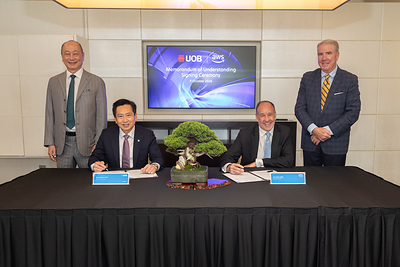
GUANGZHOU, China, Nov. 20, 2026 /PRNewswire/ -- UOB today signed a Memorandum of Understanding (MoU) with the Guangzhou Municipal Government to establish a new technology innovation centre in Guangzhou, China. The MoU marks a significant step in UOB's engagement with Guangzhou, deepening collaboration in technology and innovation, digital and green finance, talent development, and support technology and innovation companies.
The proposed centre will form part of UOB's broader technology strategy, complementing its established technology base in Singapore and capabilities across the region. By tapping Guangzhou's deep technology ecosystem and strong talent base, it will support the development and scaling of future-ready banking solutions across the Group, enabling the Bank to deliver better customer experiences across its markets. The centre will also deepen the exchange of technology talent and expertise with Guangzhou, connecting the city's innovation capabilities with opportunities across ASEAN through UOB's regional network.
Mr Wee Ee Cheong, Deputy Chairman and Chief Executive Officer of UOB, said, "UOB has been part of Guangzhou's growth for more than 30 years and the city continues to play an important role in our China strategy. This collaboration combines UOB's Group-wide capabilities with the strengths of China's technology ecosystem to advance the proposed technology innovation centre, while deepening cooperation in technology and innovation, cross-border finance and financial technology. By connecting Guangzhou's strengths with our regional network, we can help Chinese businesses expand across ASEAN and support overseas companies pursuing growth opportunities in China."
Mr Feng Zhonghua, Secretary of CPC Guangzhou Committee, said, "China and Singapore share deep-rooted ties and enjoy close cooperation. As a leading international bank headquartered in Singapore, UOB has a strong global presence and extensive network, particularly in ASEAN, serving as an important bridge for business exchanges and cooperation between the two countries. Guangzhou is strengthening its role as a core growth engine of the Guangdong-Hong Kong-Macao Greater Bay Area, advancing high standards of connectivity and developing a modern industrial system driven by both manufacturing and commerce, creating significant opportunities for businesses. UOB's decision to establish its technology innovation centre in Guangzhou represents a mutually beneficial strategic move. We hope this will mark a new chapter in our cooperation, bringing more projects and resources to Guangzhou while encouraging more international companies, particularly those from ASEAN, to invest in the Greater Bay Area and establish a presence in Guangzhou. Guangzhou will continue to foster a world-class, market-oriented, law-based and internationalised business environment, providing strong support for businesses to grow and thrive in the city."
Technology, innovation and people at the core
The proposed centre will add engineering capacity and specialist expertise to UOB's regional technology capabilities, while strategy, architecture and critical capabilities remain anchored in Singapore. UOB will also explore partnerships with universities, research institutions and technology companies in Guangzhou and the Greater Bay Area to deepen access to talent, emerging technologies and industry-academia collaboration.
Mr Lawrence Goh, Head of Group Technology and Operations of UOB, will lead the planning and development of the centre. He said, "Technology is central to how we transform the way we serve our customers and build for the future. The centre will tap Guangzhou's technology ecosystem to complement UOB's regional capabilities, strengthening our ability to innovate and scale solutions across the Group as we advance our multi-year technology transformation."
A long-term commitment to China
UOB has operated in Mainland China for more than four decades, establishing representative offices and branches in Beijing in 1984, Xiamen in 1985, Guangzhou in 1989 and Shanghai in 1998, before incorporating a subsidiary in 2007. The proposed centre builds on this long-standing presence and deepens UOB's investment in China, strengthening connectivity and growth opportunities between China and ASEAN.
Under the MoU, UOB and the Guangzhou Municipal Government will work towards the next phase of planning and assessment, with further details to be announced when finalised and subject to the necessary approvals.
– End –
About UOB
UOB is a leading Asian bank with a global network in Southeast Asia, Asia Pacific, Europe and North America. Operating through our head office in Singapore and banking subsidiaries in China, Indonesia, Malaysia, Thailand and Vietnam, we have a global network of about 430 branches and offices in 19 markets.
Since its incorporation in 1935, UOB has grown organically and through a series of strategic acquisitions. Today, UOB is rated among the world's top banks: Aa1 by Moody's Investors Service and AA- by both S&P Global Ratings and Fitch Ratings.
For more than nine decades, UOB has adopted a customer-centric approach to create long-term value by staying relevant through its enterprising spirit and doing right by its customers. UOB is focused on building the future of ASEAN – for the people and businesses within, and connecting with, ASEAN.
The Bank connects businesses to opportunities in the region with its unparalleled regional footprint and leverages data and insights to innovate and create personalised banking experiences and solutions catering to each customer's unique needs and evolving preferences. UOB is also committed to help businesses forge a sustainable future, by fostering social inclusiveness, creating positive environmental impact and pursuing economic progress. UOB believes in being a responsible financial services provider and is steadfast in its support of education, children and art, doing right by its communities and stakeholders.
SOURCE UOB





Share this article