Singapore has cut stroke mortality by up to six-fold since the 1990s, but public awareness remains the final hurdle, new report finds

Singaporean experts call for renewed public education on the FAST warning signs and continued investment in specialist staffing to sustain the country's world-leading stroke outcomes.
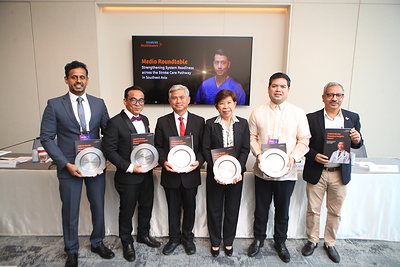
SINGAPORE, Sept. 2, 2026 /PRNewswire/ -- Singapore has cut stroke mortality by up to six-fold since the 1990s[1], but limited public awareness of stroke symptoms continues to delay patients from receiving timely treatment, according to a new report, Strengthening Stroke System Readiness Across ASEAN, unveiled today by Siemens Healthineers at Hospital Management Asia 2026 in Bangkok, Thailand.
The report draws on insights from seven leading experts across Indonesia, Malaysia, the Philippines, Singapore, Thailand and Vietnam, including A/Prof. Anil Gopinathan, Head of Neurointerventional Radiology, National University Hospital, Singapore. Globally, an estimated one in four people will experience a stroke in their lifetime[2], underscoring the importance of public vigilance. Experts identified low public awareness of the FAST warning signs — Face drooping, Arm weakness, Speech difficulty, Time to call for help — as the country's most significant remaining gap in the chain of care.
The World Health Organization's South-East Asia Region accounts for over 40% of global stroke mortality,[3] and carries nearly half of the developing world's total stroke burden, with severe long-term disability affecting roughly one-third of all stroke survivors[4]. Stroke remains the fourth leading cause of death[5] in Singapore, and the country's rapidly ageing population[6] is driving a steady rise in cases even as death rates continue to fall[7].
"Every healthcare system across Southeast Asia is at a different stage of its stroke care journey, yet many of the challenges are shared," said Fabrice Leguet, Managing Director ASEAN and Head of Enterprise Services Asia-Pacific & Japan, Siemens Healthineers.
"In Singapore, that means extending the same urgency hospitals bring to stroke care into the community, so patients and families recognise the signs and act just as quickly," said Ai Li Siow, Managing Director, Siemens Healthineers, Singapore, Malaysia and Brunei. "Improving outcomes depends on how effectively the entire stroke system works together, from recognising symptoms and activating emergency medical services to rapid diagnosis, treatment and rehabilitation."
A model for the region
Singapore demonstrates the value of long-term national stroke planning, coordinated emergency medical services and streamlined care pathways. In 2008 and 2009, the country's hospitals developed coordinated action plans for stroke response, consolidating comprehensive stroke care into three hospitals, positioned so that patients anywhere on the island can reach one within 15 to 20 minutes. Paramedics are trained to identify stroke symptoms and route patients directly to the nearest of these centres and on arrival patients bypass the emergency department entirely, going straight for a computed tomography (CT) scan, where neurologists and emergency physicians are already waiting.
Rather than a lengthy diagnostic workup, physicians use a streamlined imaging protocol – a single scan to confirm the absence of bleeding, assess stroke severity and confirm the patient is within 24 hours of onset before proceeding directly to treatment — allowing Singapore's stroke teams to move from diagnosis to treatment with speed and confidence.
Experts pointed to the value of adapting aspects of Singapore's comprehensive planning approach alongside models such as Vietnam's public-private Stroke International Services hospital in Can Tho City, as ASEAN countries look to strengthen stroke systems more broadly.
AI can support faster, more coordinated diagnosis
Artificial intelligence emerged as a tool that could further strengthen Singapore's streamlined approach, helping clinicians detect stroke events and identify affected brain tissue quickly from a single CT scan, extracting more diagnostic value from the imaging already being performed. The experts stressed, however, that technology is most effective when integrated into well-designed clinical pathways and supported by trained professionals, robust referral networks and standardised care protocols.
Priorities for strengthening stroke readiness in Singapore
With hospital-based stroke care already among the most advanced in the region, experts agreed that Singapore's next priorities lie mainly in the community and the workforce that supports its hospitals:
- Strengthening public education on the FAST warning signs to reduce delays in calling for emergency help
- Sustaining round-the-clock specialist staffing, particularly stroke nurses and cath lab teams, as demand grows
- Preparing for rising stroke incidence driven by an ageing population, without compromising rapid response times
"Stroke care depends on a chain of decisions and actions that begins before a patient reaches hospital. No single institution or technology can strengthen that chain alone," said Siow. "Singapore has built a system where help is never far away. The next step is making sure every patient calls for it in time."
Read the full report here.
Visit the Siemens Healthineers Press Center.
Subscribe to our "Medtech matters" newsletter on LinkedIn.
Siemens Healthineers pioneers breakthroughs in healthcare. For everyone. Everywhere. Sustainably. The company is a global provider of healthcare equipment, solutions and services, with activities in more than 180 countries and direct representation in more than 70. The group comprises Siemens Healthineers AG, listed as SHL in Frankfurt, Germany, and its subsidiaries. As a leading medical technology company, Siemens Healthineers is committed to improving access to healthcare for underserved communities worldwide and is striving to overcome the most threatening diseases. The company is principally active in the areas of imaging, diagnostics, cancer care and minimally invasive therapies, augmented by digital technology and artificial intelligence. In fiscal 2025, which ended on September 30, 2025, Siemens Healthineers had approximately 74,000 employees worldwide and generated revenue of around €23.4 billion. Further information is available at siemens-healthineers.com.
[1] Ministry of Health, Singapore. Age-Standardised Mortality Rate for Stroke [Dataset]. data.gov.sg https://data.gov.sg/datasets/d_e3f0c53137e5ee11b6df121ec4987bb7/view. |
[2] Feigin VL, Nguyen G, Cercy K, et al. (GBD 2016 Lifetime Risk of Stroke Collaborators). Global, Regional, and Country-Specific Lifetime Risks of Stroke, 1990 and 2016. New England Journal of Medicine. 2018;379(25):2429–2437. doi:10.1056/NEJMoa1804492 |
[3] Pandian JD, Padma Srivastava MV, Aaron S, et al. The burden, risk factors and unique etiologies of stroke in South-East Asia Region (SEAR). Lancet Reg Health Southeast Asia. 2023; 17:100290. doi:10.1016/j.lansea.2023.100290 |
[4] Ng JC, Churojana A, Pongpech S, et al. Current state of acute stroke care in Southeast Asian countries. Interv Neuroradiol. 2019; 25(3): 291-296. doi:10.1177/1591019918811804 |
[5] https://www.moh.gov.sg/others/resources-and-statistics/principal-causes-of-death/ |
[6] Ministry of Health, Singapore. Ageing in the Community. moh.gov.sg. |
[7] Hung J, De Silva DA, Seet RCS. Declining Stroke Mortality in Singapore and The Challenges Ahead. Annals of the Academy of Medicine, Singapore. 2019;48(10):310–313. |
SOURCE Siemens Healthineers





Share this article