Cathay FHC Convenes Asia's Leading Climate Finance Summit as Record Participation Signals Growing Momentum for Sustainable Transition

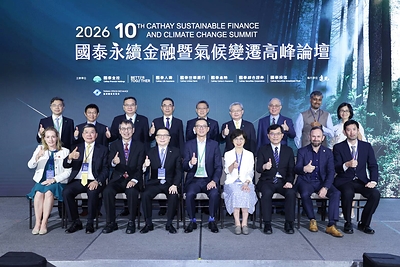
TAIPEI, July 8, 2026 /PRNewswire/ -- More than 5,800 participants from over 2,000 organizations joined the 10th Cathay Sustainability Finance & Climate Change Summit on July 1, making this year's event the largest on record. The summit brought together more than 850 listed companies representing over 80% of Taiwan's market capitalization, alongside policymakers, global investors, business leaders and international experts, reinforcing Cathay Financial Holdings' (Cathay FHC) position as one of Asia's leading conveners of climate finance dialogue and sustainable transition.
As global sustainable finance enters a new phase shaped by geopolitical uncertainty, accelerating the energy transition and growing demand for transition capital, Asia is emerging as a critical engine for mobilizing investment, technology and innovation. Against this backdrop, Cathay FHC's annual summit has evolved into one of Asia's leading platforms for sustainable finance dialogue. It brings together policymakers, investors, businesses and academia to help shape the region's next phase of resilient and inclusive growth.
The summit opened with congratulatory video messages from former U.S. Vice President Al Gore, whose support inspired the inaugural summit in 2017, and Jin-lung Peng, Chairman of Taiwan's Financial Supervisory Commission (FSC). Distinguished speakers included Chin-Tsang Ho, Vice Minister of Economic Affairs, Sherman Lin, Chairman of the Taiwan Stock Exchange, Sherri Chuang, Vice Chairperson of Taiwan's FSC, Rebecca Mikula-Wright, CEO of the Asia Investor Group on Climate Change (AIGCC), Professor Ryo Kohsaka of the University of Tokyo, Sam Kimmins, Energy Director at Climate Group, and Taiwan Power Company Chairman Vincent Tseng, highlighting the summit's growing role as a platform where international perspectives converge with Asia's transition agenda.
Climate Change Has Become a Systemic Challenge
Opening the summit, Cathay FHC President Chang-Ken (CK) Lee emphasized that climate change has evolved from an environmental issue into a systemic risk affecting economic development, industrial competitiveness, financial markets and people's daily lives.
Reflecting on his participation in London Climate Action Week just days earlier, Lee noted that temperatures reached 37–38°C during the event, highlighting how climate change is already reshaping societies. He also pointed to the disproportionate impact on vulnerable communities, many of whom lack the financial resources to adapt to increasingly frequent climate extremes.
Lee reaffirmed Cathay FHC's long-standing commitment to three core principles: creating long-term value, driving innovation, and fostering collaboration. "Financial institutions have a unique responsibility to allocate capital toward long-term value creation," Lee said. "Innovation in clean energy, low-carbon technologies, natural capital and the circular economy is redefining future industries. Sustainability is no longer separate from growth—it is increasingly becoming a key driver of long-term competitiveness. Equally important is collaboration across sectors and markets, enabling Asia to accelerate practical solutions while contributing to the global transition."
Turning to the summit's evolution over the past decade, Lee noted that its discussions have expanded from raising awareness of climate change and strengthening climate governance to encompass water stewardship, natural capital, blended finance, financial innovation and people-centered impact investing. "With more successful sustainable finance investments emerging around the world, the next decade should focus on scaling proven solutions and transforming shared commitments into tangible outcomes," he added.
Recognition from Global and National Leaders
In his congratulatory video, FSC Chairman Jin-lung Peng praised Cathay FHC's decade-long contribution to advancing sustainable finance and climate action in Taiwan. Quoting the Chinese saying "Virtue is never alone; it always attracts companions," Peng emphasized that financial institutions are not only providers of capital but also important drivers of industrial transformation. He reaffirmed the FSC's commitment to strengthening Taiwan's green and transition finance markets while encouraging financial institutions to develop innovative financial solutions that help businesses accelerate their transitions and strengthen their resilience.
Former U.S. Vice President Al Gore, who attended the inaugural summit in person in 2017, also congratulated Cathay FHC on the summit's tenth anniversary through a special video message. Gore said he was pleased to see this summit become Taiwan's leading platform for sustainable finance dialogue. He commended Cathay FHC and participants for continuing to demonstrate leadership despite growing global uncertainty over sustainability commitments.
He also emphasized that although the global energy transition continues to face challenges, financial markets are moving decisively from fossil fuels toward clean energy solutions, making the transition irreversible. Gore encouraged financial institutions and the private sector to continue directing capital toward building sustainable economies and resilient societies.
Shaping Asia's Next Decade of Sustainable Finance
This year's summit, themed "Innovating for a Resilient Sustainable Future," focused on how governments, financial institutions, businesses and innovators can accelerate Asia's transition through policy alignment, capital mobilization, technological innovation and cross-sector collaboration.
The morning sessions explored how to remain committed to sustainability amid global uncertainty, with policymakers outlining Taiwan's latest sustainable finance policies, strategies for supporting innovative sustainable enterprises, and Taiwan's broader green transition strategy.
Rebecca Mikula-Wright, CEO of AIGCC, shared the latest outlook from Asian institutional investors, noting that climate risk is now widely recognized as financial risk, while geopolitical developments continue to reshape energy systems and accelerate investment in the net-zero transition.
Professor Ryo Kohsaka of the University of Tokyo, who also serves as a Coordinating Lead Author of the Intergovernmental Science-Policy Platform on Biodiversity and Ecosystem Services (IPBES), discussed Japan's Nature Positive strategy and shared insights into how businesses can integrate nature-related risks and opportunities into corporate decision-making.
The afternoon sessions focused on "Accelerating Innovation and Building Resilience," covering energy transition, natural capital, social inclusion and industry-led solutions. Sam Kimmins, Energy Director at Climate Group, examined Asia's energy security challenges and discussed opportunities to advance 24/7 Carbon-Free Energy (24/7 CFE) in Taiwan. He also commended Cathay FHC for its bold action in this field as the world's first financial institution to join the initiative.
Taiwan Power Company Chairman Vincent Tseng shared the latest developments in Taiwan's electricity system and discussed how energy transition can balance power reliability, net-zero ambitions and industrial competitiveness.
Two concluding panel discussions explored cross-sector examples of low-carbon transformation and Taiwan's growing ecosystem for sustainability innovation. Speakers discussed how digital technologies, energy efficiency, green financial products and supply chain collaboration can strengthen corporate resilience while addressing the financing and policy challenges facing sustainable start-ups across Asia.
Building Asia's Climate Finance Ecosystem
Over the past decade, Cathay FHC's Sustainability Finance & Climate Change Summit has grown from a domestic initiative into one of Asia's most influential platforms for sustainable finance dialogue. Since its launch in 2017, the summit has welcomed more than 150 international and domestic thought leaders. For three consecutive years, participating companies have represented more than 80% of Taiwan's listed market capitalization and over half of the country's carbon emissions, underscoring the summit's growing influence in advancing real-economy transition.
Looking ahead, Cathay FHC said it will continue expanding the summit as a regional platform that brings together capital, policy and innovation to accelerate Asia's transition toward a resilient, low-carbon and nature-positive economy. Through deeper collaboration with governments, businesses, academia and international partners, Cathay FHC aims to help strengthen Asia's sustainable finance ecosystem and reinforce the region's role in driving the next phase of global climate action.
SOURCE Cathay Financial Holdings




Share this article